A Walk Through a Hospital Toy Closet
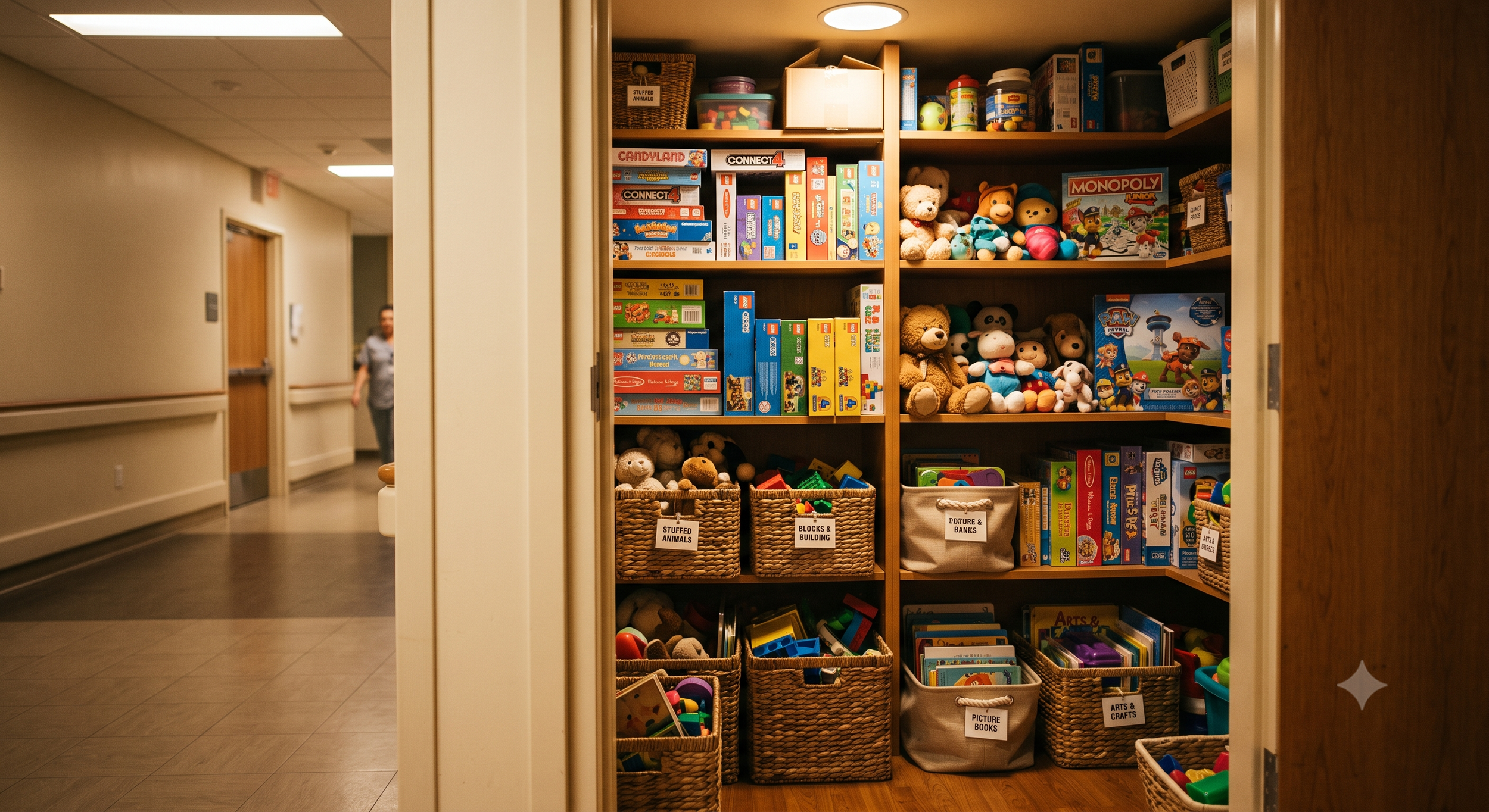
Most people have never seen a hospital toy closet.
If you have not been a cancer family, you would not have a reason to. The closet is on a clinic floor, behind a heavy door, in a room with a few rolling carts and shelves of sensory toys and crayons and art supplies and small plush animals organized by age.
I want to take you on a small walk-through. Because the toy closet is one of the most underappreciated rooms in pediatric medicine, and the work that happens in it is some of the most important.
What a hospital toy closet looks like
It varies by hospital. The toy closet at Advocate Children's Hospital in Park Ridge is a small room off the pediatric oncology hallway. It has a window. The shelves are organized by age. The wall above the supplies has a hand-lettered sign that says "Joy Lives Here." The sign is taped on with packing tape and has been there for years.
Other hospitals have larger closets. Lurie's is a multi-room space. Comer's is a closet plus a few rolling carts. Each hospital sets up the closet a little differently. The principle is the same.
What is on the shelves
By age, roughly
Infants and toddlers: small soft plush animals (machine-washable), board books, rattle toys, simple sensory items. Anything that is safe to mouth.
Preschoolers: small puzzles, sensory balls, Play-Doh, finger paints, sticker books, simple craft kits.
Early elementary: more complex puzzles, building sets (small Lego, Magna-Tiles), drawing supplies, friendship bracelet kits, small wooden cars and dolls.
Late elementary and middle school: more advanced art kits, model kits, books in middle-grade reading levels, card games, jewelry-making kits, journals.
Teens: gift cards (Target, Amazon), beauty and skincare items, journals, headphones, sketchbooks, fidgets that look age-appropriate.
By function
Procedural toys: pop-its, bubble wands, kaleidoscopes, sensory balls, small fidgets. These come out for port access, blood draws, dressing changes.
Long-stay toys: building sets, art supplies, books, card games. For inpatient days that turn into inpatient weeks.
Joy items: small plush animals, comfort items, holiday-themed treats during specific seasons.
Sibling items: a separate small shelf for the brothers and sisters who come with their parents to clinic.
Who uses the closet
Child life specialists
Most often. They are the people who walk into the closet several times a day to pull a toy for a child about to have a procedure, or to restock a cart that goes from room to room on the inpatient floor.
Pediatric oncology nurses
Nurses pull from the closet when a child needs something specific in the middle of an infusion. A sensory ball for the kid who is starting to dysregulate. A pop-it for the kid about to get accessed. A small plush for the child whose port placement was harder than expected.
Social workers
Social workers pull from the closet for the Newly Diagnosed Family Bags and for special situations. A teen who is having a hard month. A sibling who came along to a long appointment.
Parents, sometimes
Some hospitals invite parents to the closet to pick something for their child. Most run the closet through staff to keep the inventory predictable.
Where the toys come from
Organizations like Maxwell's Toy Box
We restock the closets at our four partner hospitals year-round. Sensory toys, art supplies, Joy Packages, small plush animals, age-appropriate items in steady rotation. We coordinate with the child life teams to deliver what they need most.
In 2025, we delivered 8,573 toys and art supplies across our four partner hospitals. Most of those items went into toy closets and were distributed by child life specialists to children in active treatment.
Community toy drives
Families, workplaces, schools, and faith communities host toy drives that send unopened toys to the closet through partner organizations like ours.
Holiday and seasonal drives
Most hospitals receive a heavy influx of toys around the December holidays. Toy closets are full from December through February, and then they start to empty. By the spring, most pediatric oncology toy closets are running low. This is why year-round support matters so much.
Direct donations from individuals
Some individual donors deliver toys directly to the hospital. Most hospitals have an intake process for this. The toys are inspected, sanitized if needed, and shelved.
Why this room matters
The toy closet is not decorative. The toys are not extras. They are clinical tools.
A child who walks into clinic and reaches for a familiar pop-it is a child whose nervous system is regulating before the access happens.
A child who has a Joy Package on their lap during a long drip is a child whose hands are occupied, whose mind is engaged, whose body is calmer.
A sibling who picks a small toy from the sibling shelf is a sibling who feels seen.
A teen who gets a Target gift card before their final week of consolidation is a teen who feels remembered.
A newly diagnosed family who is handed a bag with toys, books, sensory items, a hand-written note, and a guide is a family whose first day in pediatric oncology is softer than it would have been otherwise.
A thank-you to the people who keep the closets stocked
If you are a child life specialist, a pediatric oncology nurse, a hospital social worker, or a volunteer who has stocked a hospital toy closet, thank you. The work you do in that small room is some of the most important work in pediatric medicine.
If you have donated a toy that ended up in a closet, thank you. Your toy became a tool. Your tool became a moment of regulation, calm, or joy for a child in treatment.
A note from Maxwell's Toy Box
We are honored to be one of the year-round stocking partners for the toy closets at our four partner hospitals. We do not deliver toys to make ourselves feel better. We deliver toys because hospitals run out, and children need the tools the closet provides.
Dina
Mom of Max | Founder, Maxwell’s Toy Shoppe
Childhood Cancer Advocate 💛
Follow Us On Social
Join our movement to support children battling cancer and their families, year-round:
🎁 Donate to deliver toys to children during long cancer treatment days
🧸 Buy a toy from Maxwell’s Toy Shoppe, and 100% of proceeds support children in treatment
🎗️ Join Maxwell’s Circle of Heroes as a monthly donor to ensure families receive ongoing care