Behind the Scenes of a Joy Package Delivery Day
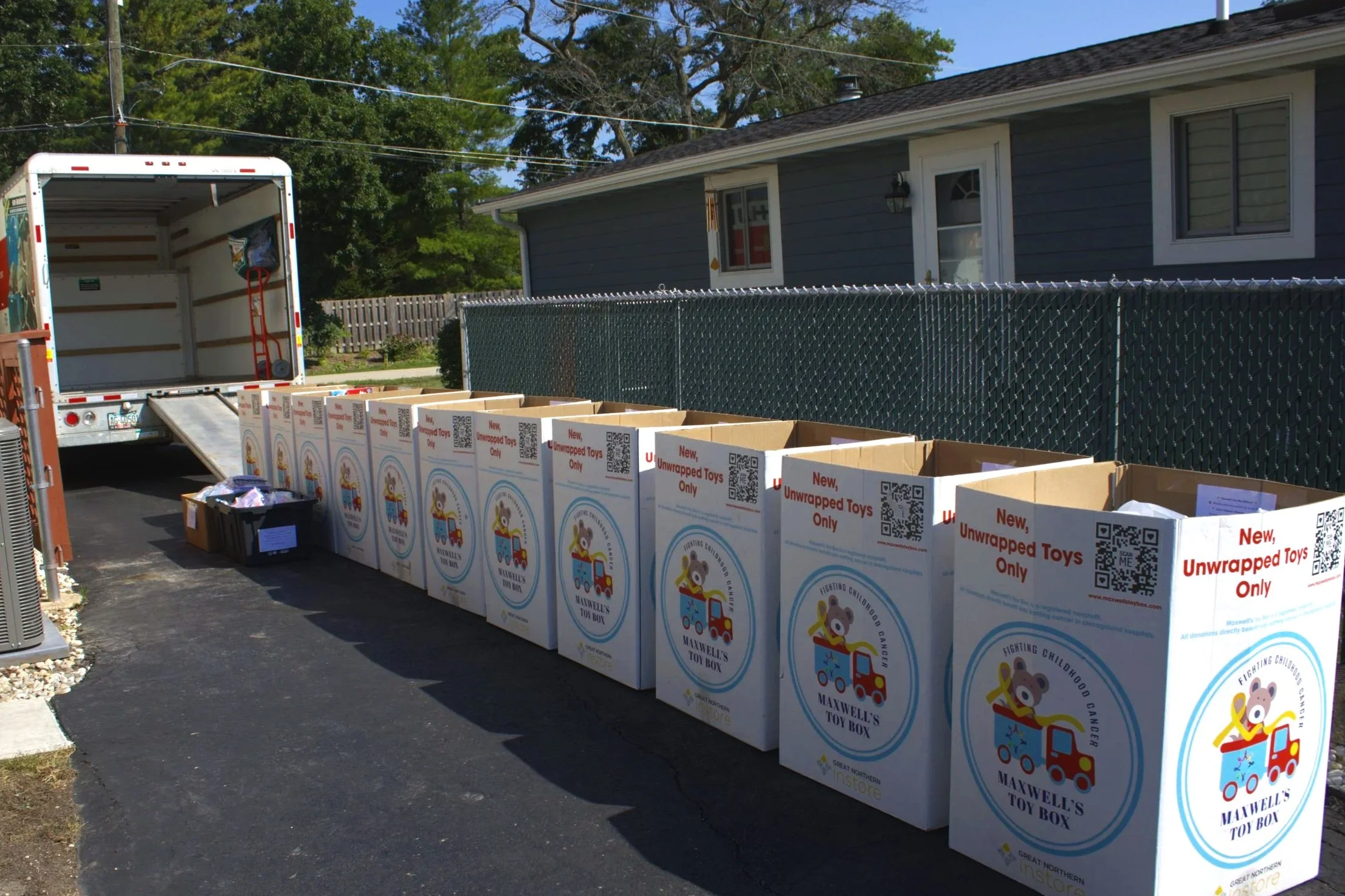
I want to walk you through what a Joy Package delivery day looks like at Maxwell's Toy Box, because a lot of our supporters ask, and because these days are one of my favorite parts of what our organization does.
The morning before
A delivery day at Maxwell's Toy Box starts the day before, in our warehouse in Lake Bluff. Our volunteer team meets to pack. We assemble Joy Packages the same way every time. Sensory ball, pop-it, Slinky, markers, coloring book, stickers, Play-Doh, finger puppet, picture book, one card for the child, one card for the parent. The bags line up on folding tables. We work through the batch together.
Every bag gets checked twice before it's zipped. We check for the two cards. We check that the seasonal item (this month, our CCAM gold-ribbon-themed coloring book) is included. We check that the age-appropriate book is matched to the age band. When we hit our packing target for the day, the bags get loaded into transit bins and stacked in the corner of the warehouse, ready for the morning drive.
Delivery morning
On a delivery morning, our team meets early. The bins get loaded into vehicles. Depending on the hospital we're delivering to that day, the drive is 20 minutes to an hour from Lake Bluff.
We deliver to four partner hospitals across Chicagoland: Advocate Children's Hospital in Park Ridge, Advocate Children's Hospital in Oak Lawn, Ann & Robert H. Lurie Children's Hospital of Chicago, and UChicago Medicine Comer Children's Hospital. Each hospital's pediatric oncology program has its own rhythm. We work with the child life specialists and social work teams at each site to make sure our deliveries land at the right moments in their weekly schedule.
The hospital handoff
When we arrive at a partner hospital, we go in through the loading area or the family services entrance, depending on the site. We meet the child life specialist or social worker who is coordinating the intake. The bins come off the vehicle. We spend a few minutes catching up. What's the volume like this week. Which units need what. Is there a specific family they'd like us to send something extra for. Which age bands are running short on inventory.
This handoff is the part of the process most donors don't see. It's also where the year-round partnership shows up. We aren't dropping off toys and leaving. We're in a relationship with each hospital's team. They know our packing rhythm. We know their distribution needs.
What happens after we leave
The bags don't get distributed in a single moment. They live in the hospital's toy closet or family support area, and the child life specialists and social workers hand them out over the following days and weeks. Some go to a child on their first day of a new chemo cycle. Some go to a child who's been inpatient for a long stretch. Some go to a family whose child has had a hard morning. Some go to a sibling who came along and needs something to carry.
We usually get photos back over the following weeks. A child in a clinic chair holding one of the sensory balls. A drawing done on our coloring book pages. A note from a parent forwarded through the social work team. These are the moments that get me through every long delivery drive.
What one delivery cycle looks like
In a typical delivery week during peak treatment season, we might send 100 or more Joy Packages across the four hospitals combined. In 2025, our total distribution was 4,024 Joy Packages. That's roughly 335 a month, though the pace fluctuates with hospital demand and seasonal need.
At $25 per Joy Package, that means our year of Joy Package deliveries in 2025 represented about $100,000 in packed bags. That number is mostly funded by individual donations and sponsorships. Every $25 sponsor is a real bag on a real cart in a real hospital hallway.
How this connects to the treatment advocacy work
This is the part I want to be direct about. We wouldn't need to send as many Joy Packages as we do if pediatric cancer treatment had advanced the way it should have over the last several decades.
The children who receive our bags are on chemotherapy protocols built around drugs developed in the 1950s, 60s, and 70s. Those drugs save lives. They also produce the specific side effects and long clinic days that make our Joy Packages necessary in the first place. Every sensory ball we send is, in one sense, a small measurement of the treatment gap.
We will keep sending Joy Packages for as long as children are in treatment. We would also love, over the next decade, for that number to shift. Not because our organization gets smaller. Because the children we serve need fewer coping tools because their treatments have gotten gentler.
That shift, when it comes, will come from research funding. Which is why every advocacy conversation this September, and every donation to a pediatric cancer research foundation like St. Baldrick's, is part of the same work as the Joy Packages themselves.
How to be part of a Joy Package delivery
If you'd like to sponsor a Joy Package, the link is maxwellstoybox.com/donate. $25 goes to one bag delivered to one child.
If you're local to Chicagoland and would like to volunteer with a packing day, you can reach us at maxwellstoybox.com/volunteer-with-us.
If you'd like to host a toy drive for us, maxwellstoybox.com/host-a-toy-drive walks you through it.
Every one of those paths connects to a real bag on a real cart in a real hospital. Thank you for being part of it.
Dina
Mom of Max | Founder, Maxwell’s Toy Shoppe
Childhood Cancer Advocate 💛
Follow Us On Social
Join our movement to support children battling cancer and their families, year-round:
🎁 Donate to deliver toys to children during long cancer treatment days
🧸 Buy a toy from Maxwell’s Toy Shoppe, and 100% of proceeds support children in treatment
🎗️ Join Maxwell’s Circle of Heroes as a monthly donor to ensure families receive ongoing care