10 Questions to Ask Your Oncologist (A Starter List for Cancer Parents)
If your child has just been diagnosed with cancer, you are about to have a series of conversations with your oncology team that will shape the next months and years of your family's life.
You will be given a lot of information. You will not remember most of it the first time. You will have questions you do not know how to ask yet. You will sometimes leave an appointment realizing you forgot to ask the most important thing.
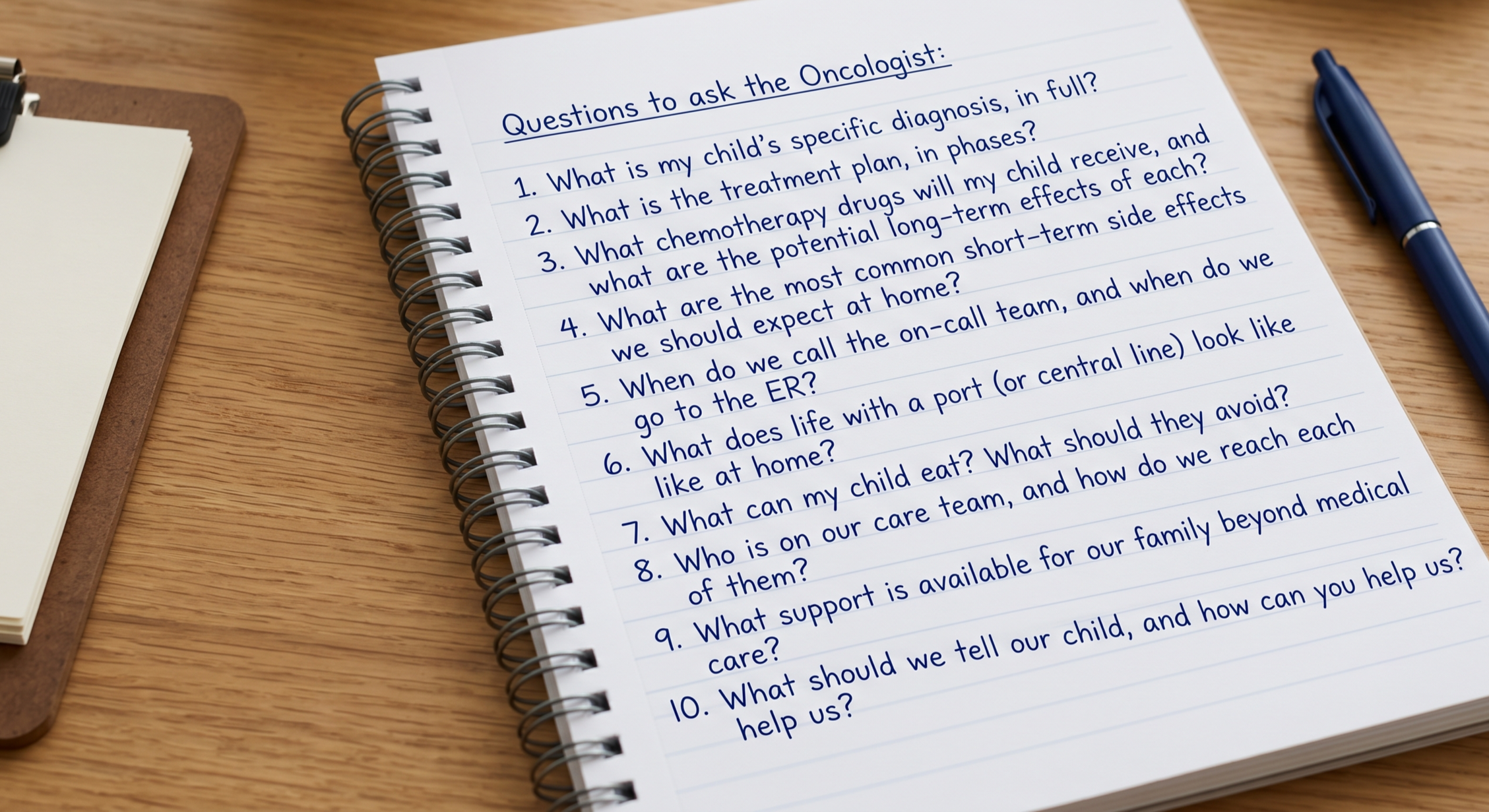
This is a starter list of 10 questions to bring to your first few appointments. Print it. Bring it. Add to it. Your oncology team will be glad you brought it. Most are used to parents arriving with a list, and many are quietly disappointed when parents do not.
The 10 questions
1. What is my child's specific diagnosis, in full?
Ask for the exact name. Many pediatric cancers have subtypes that affect treatment. "Acute lymphoblastic leukemia" is the general diagnosis. The specific subtype (B-cell vs T-cell, standard risk vs high risk, etc.) determines a lot of what comes next.
Write the full name down. You will need it for insurance, school, second opinions, and your own future understanding.
2. What is the treatment plan, in phases?
Most pediatric cancer treatments are organized into phases (induction, consolidation, maintenance, etc.). Ask your team to walk you through the phases your child will experience, the rough timeline of each, and what to expect during each one.
This is the calendar of your next several years. Understanding it gives you a frame to plan around.
3. What chemotherapy drugs will my child receive, and what are the potential long-term effects of each?
Knowing the names of the chemotherapy drugs your child is receiving is important for survivorship care later. Some drugs have specific long-term monitoring needs (cardiac, hearing, fertility). Ask now. Write it down. Save the list.
4. What are the most common short-term side effects we should expect at home?
Hair loss. Nausea. Fatigue. Mouth sores. Steroid moods. Neutropenia. Your team can tell you which side effects are most likely with your child's specific protocol, and what helps each one.
Knowing what to expect makes the side effects less scary when they show up.
5. When do we call the on-call team, and when do we go to the ER?
This is the question that will save you the most middle-of-the-night anxiety. Get a clear list. What fever threshold triggers a call? When do we go directly to the ER? What is the on-call number? Who is on call after hours? Where do we go if we are not near our home hospital?
Save the answers in both parents' phones. Tape a copy to the fridge.
6. What does life with a port (or central line) look like at home?
If your child is getting a port or central line, ask your team to walk you through care. What does the dressing look like? When does it get changed? What are signs of infection? What activities are restricted?
If you can, ask for a printout. There is a lot to remember.
7. What can my child eat? What should they avoid?
Cancer treatment can change appetite, taste, and what foods are safe (especially during neutropenia). Ask for the food rules your child should follow at home and during neutropenic phases. Ask about supplements, vitamins, and any over-the-counter meds.
8. Who is on our care team, and how do we reach each of them?
Pediatric oncology care is multidisciplinary. You will have a primary oncologist, nurse practitioners, infusion nurses, child life specialists, a social worker, and sometimes a pharmacist or dietitian. Ask who is on your specific team and how to reach each of them.
Get the social worker's name and contact info early. They handle some of the most useful family support, and many families do not connect with them until late in treatment.
9. What support is available for our family beyond medical care?
Ask about financial assistance, transportation help, lodging during inpatient stays, sibling support, mental health resources, and community organizations the hospital partners with.
Many pediatric oncology programs have a list of vetted partner organizations. Ask for the list. Maxwell's Toy Box may be on it.
10. What should we tell our child, and how can you help us?
Ask your team for guidance on how to talk to your child about their diagnosis, by age. Ask if the child life specialist can help. Ask what resources the team uses for talking with siblings.
This is one of the most important conversations of your parenting life. Your team can help.
A few logistics tips
Bring a notebook to every appointment
You will not remember half of what is said in any given appointment. Write it down. Date each set of notes. The notebook will become an invaluable record over time.
Bring two adults to early appointments when possible
Four ears are better than two. One person can take notes while the other listens. One person can ask follow-up questions while the other processes.
Repeat back what you heard
At the end of each appointment, say back to your team in your own words what you understood. This catches misunderstandings before they leave the room.
Ask for written summaries
Most hospital portals have post-visit summaries. Read them. They often clarify things you did not fully absorb in the room.
A note for the parent reading this
Your oncology team wants you to ask questions. They want you to bring lists. They want you to come back next week with more questions after you have had time to process. There are no silly questions. There are no annoying questions. Every question you ask makes you a more capable partner in your child's care.
Dina
Mom of Max | Founder, Maxwell’s Toy Shoppe
Childhood Cancer Advocate 💛
Follow Us On Social
Join our movement to support children battling cancer and their families, year-round:
🎁 Donate to deliver toys to children during long cancer treatment days
🧸 Buy a toy from Maxwell’s Toy Shoppe, and 100% of proceeds support children in treatment
🎗️ Join Maxwell’s Circle of Heroes as a monthly donor to ensure families receive ongoing care